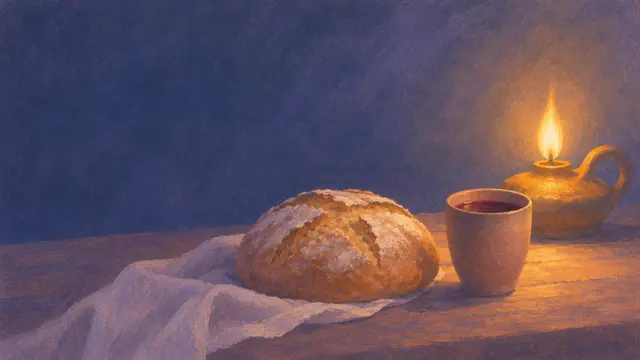
Communion, also called the Lord's Supper or the Eucharist, is the meal of bread and cup that Jesus gave his followers on the night before he died. These Bible verses about communion include the accounts of the Last Supper in Matthew, Mark and Luke, and Paul's instructions in 1 Corinthians 11:26 to eat and drink until he comes.
Most-loved Bible verses about communion
For as often as you eat this bread and drink this cup, you proclaim the Lord’s death until He comes.
Paul writes to a church that had made the meal a source of division. He says each time believers eat the bread and drink the cup, they proclaim Jesus' death until he returns.
While they were eating, Jesus took bread, spoke a blessing and broke it, and gave it to the disciples, saying, “Take and eat; this is My body.” Then He took the cup, gave thanks, and gave it to them, saying, “Drink from it, all of you. This is My blood of the covenant, which is poured out for many for the forgiveness of sins.
Jesus shares this meal with his disciples while eating the Passover. He ties the bread and cup to his body and blood, and says his blood is poured out for the forgiveness of sins.
Is not the cup of blessing that we bless a participation in the blood of Christ? And is not the bread that we break a participation in the body of Christ?
Paul asks whether the cup of blessing is a participation in the blood of Christ. The word translated participation can also be read as sharing or fellowship, and traditions understand it in different ways.
And He took the bread, gave thanks and broke it, and gave it to them, saying, “This is My body, given for you; do this in remembrance of Me.” In the same way, after supper He took the cup, saying, “This cup is the new covenant in My blood, which is poured out for you.
Luke's account adds the instruction to do this in remembrance of him. He also speaks of the cup as the new covenant in his blood, which is poured out for you.
and when He had given thanks, He broke it and said, “This is My body, which is for you; do this in remembrance of Me.”
Paul passes on what he received about the Last Supper. Jesus says the bread is his body for you, and asks his followers to eat in remembrance of him.
While they were eating, Jesus took bread, spoke a blessing and broke it, and gave it to the disciples, saying, “Take it; this is My body.” Then He took the cup, gave thanks, and gave it to them, and they all drank from it. He said to them, “This is My blood of the covenant, which is poured out for many. Truly I tell you, I will no longer drink of the fruit of the vine until that day when I drink it anew in the kingdom of God.”
Mark's account is probably the earliest of the Gospels. It records Jesus saying he would not drink again of the fruit of the vine until the day he drinks it new in God's kingdom.
In the same way, after supper He took the cup, saying, “This cup is the new covenant in My blood; do this, as often as you drink it, in remembrance of Me.”
Paul says the cup is the new covenant in Jesus' blood, and that it should be done in remembrance. The new covenant echoes the promise in Jeremiah 31.
Because there is one loaf, we who are many are one body; for we all partake of the one loaf.
Paul says that because there is one loaf, the many are one body. In Corinth, where rich and poor ate separately, this was a rebuke as well as a picture of unity.
They devoted themselves to the apostles’ teaching and to the fellowship, to the breaking of bread and to prayer.
Luke describes the first believers after Pentecost. Breaking bread is listed with teaching, fellowship and prayer, so shared meals were a regular part of their life together.
On the first day of the week we came together to break bread. Since Paul was ready to leave the next day, he talked to them and kept on speaking until midnight.
In Troas, believers gathered on the first day of the week to break bread. Paul spoke until midnight, which is a glimpse of how early Christians met.
Therefore, whoever eats the bread or drinks the cup of the Lord in an unworthy manner will be guilty of sinning against the body and blood of the Lord. Each one must examine himself before he eats of the bread and drinks of the cup. For anyone who eats and drinks without recognizing the body eats and drinks judgment on himself.
Paul warns that eating or drinking in an unworthy manner makes a person guilty. The context is a church where people ate selfishly, so he tells them to examine themselves first.
We proclaim to you what we have seen and heard, so that you also may have fellowship with us. And this fellowship of ours is with the Father and with His Son, Jesus Christ.
John writes about fellowship with God and with one another. The word is the same one used for participation in the meal, which is why it often appears with communion.
I am the living bread that came down from heaven. If anyone eats of this bread, he will live forever. And this bread, which I will give for the life of the world, is My flesh.”
Jesus says this after feeding the crowd. Some in the audience found it hard, and Christians have read this teaching in different ways, including in connection with the Lord's Supper.
That is why many among you are weak and sick, and a number of you have fallen asleep.
Paul links the illness and death of some in Corinth to how they were treating the meal. Readers differ on how directly to apply this, but it shows how seriously Paul took it.
The grace of the Lord Jesus Christ, and the love of God, and the fellowship of the Holy Spirit be with all of you.
Paul closes 2 Corinthians with a blessing that names Father, Son and Spirit. Fellowship of the Spirit is the shared life that communion expresses.
For the bread of God is He who comes down from heaven and gives life to the world.”
Jesus says this after the crowd asks for bread like the manna their ancestors had. He says the true bread gives life to the world, which Christians relate to communion.
While He was reclining at the table with them, He took bread, spoke a blessing and broke it, and gave it to them.
After the resurrection, Jesus sat at table with two disciples on the road to Emmaus. When he took bread and blessed and broke it, they recognised him.
that all of them may be one, as You, Father, are in Me, and I am in You. May they also be in Us, so that the world may believe that You sent Me.
Jesus prays that all believers may be one, as he and the Father are one. Communion is often used as a sign of that oneness.
Jesus answered, “I am the bread of life. Whoever comes to Me will never hunger, and whoever believes in Me will never thirst.
Jesus calls himself the bread of life and promises that those who come to him will not go hungry. It explains the meaning behind the bread of communion.
I tell you, I will not drink of this fruit of the vine from now on until that day when I drink it anew with you in My Father’s kingdom.”
Jesus tells the disciples at the Last Supper that he won't drink wine again until the kingdom. Communion looks forward to that day as well as back to the cross.
What the Bible says about communion
Communion begins at the Last Supper. Matthew 26:26–28, Mark 14:22–25 and Luke 22:19–20 each record Jesus taking bread, giving thanks, breaking it and passing it to his disciples, then sharing a cup. He links the bread with his body and the cup with his blood of the covenant, poured out for many. Paul passes on the same tradition in 1 Corinthians 11:23–26 as something he received.
Christians read these words in different ways. Some traditions teach that Christ is truly present in the bread and wine, others that he is present spiritually, and others that the meal is mainly a memorial. All of them can point to the same verses, including 1 Corinthians 10:16, which calls the cup a participation in the blood of Christ. Each tradition also has its own practice about who may receive.
The passages share some common themes. It is a remembrance (1 Corinthians 11:24), a proclamation of his death until he returns (1 Corinthians 11:26), and a sign of unity, since there is one loaf and many people are one body (1 Corinthians 10:17). Paul also gives a warning in 1 Corinthians 11:27–29 about eating in an unworthy manner, and he asks people to examine themselves.
If you are preparing for communion, or for a first communion, you might read Luke 22:19–20 slowly and then John 6:35, where Jesus calls himself the bread of life. Check with your own church about how it celebrates the meal.
Bible verses about the eucharist
The word Eucharist means thanksgiving and is used by many traditions. These verses from John 6 and 1 Corinthians are central to how they understand the meal.
So Jesus said to them, “Truly, truly, I tell you, unless you eat the flesh and drink the blood of the Son of Man, you have no life in you.
This is the bread that came down from heaven. Unlike your fathers, who ate the manna and died, the one who eats this bread will live forever.”
For I received from the Lord what I also passed on to you: The Lord Jesus, on the night He was betrayed, took bread,
Jesus replied, “It is also written: ‘Do not put the Lord your God to the test.’”
Truly, truly, I tell you, he who believes has eternal life. I am the bread of life. Your fathers ate the manna in the wilderness, yet they died. This is the bread that comes down from heaven, so that anyone may eat of it and not die.
Bible verses about holy communion
Holy communion is tied to Christ's sacrifice. These verses speak of healing through his wounds, living water, a cleansed conscience and the Lamb of God.
But He was pierced for our transgressions, He was crushed for our iniquities; the punishment that brought us peace was upon Him, and by His stripes we are healed.
But whoever drinks the water I give him will never thirst. Indeed, the water I give him will become in him a fount of water springing up to eternal life.”
let us draw near with a sincere heart in full assurance of faith, having our hearts sprinkled to cleanse us from a guilty conscience and our bodies washed with pure water.
Once again, Jesus spoke to the people and said, “I am the light of the world. Whoever follows Me will never walk in the darkness, but will have the light of life.”
The next day John saw Jesus coming toward him and said, “Look, the Lamb of God, who takes away the sin of the world!
Bible verses about first communion
Communion is a time to prepare the heart. These verses speak of putting God first, being corrected by the Lord, Christ our Passover lamb and meeting together as believers.
But seek first the kingdom of God and His righteousness, and all these things will be added unto you.
But when we are judged by the Lord, we are being disciplined so that we will not be condemned with the world.
Get rid of the old leaven, that you may be a new unleavened batch, as you really are. For Christ, our Passover lamb, has been sacrificed.
Let us not neglect meeting together, as some have made a habit, but let us encourage one another, and all the more as you see the Day approaching.
Don’t you have your own homes in which to eat and drink? Or do you despise the church of God and humiliate those who have nothing? What can I say to you? Shall I praise you for this? No, I will not!