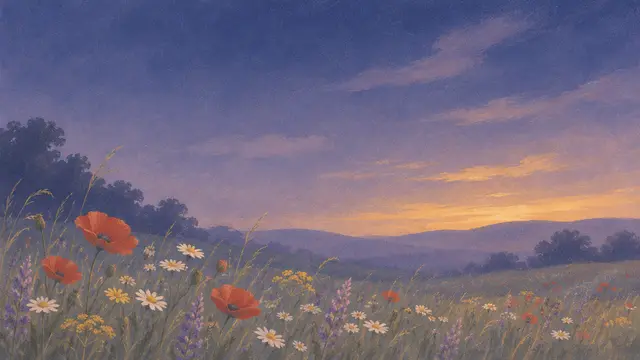
Flowers turn up in the Bible as pictures of beauty, of how short life is and of God's care for small things. These Bible verses about flowers include Isaiah 40:8, which says flowers fall but God's word stands, and Matthew 6:28–29, where Jesus tells people to look at the lilies.
Most-loved Bible verses about flowers
The grass withers and the flowers fall, but the word of our God stands forever.”
This comes in a section of comfort for exiles. Everything human fades, but God's word stands, and that is the reason people can lean on it when everything else seems to wither.
The flowers have appeared in the countryside; the season of singing has come, and the cooing of turtledoves is heard in our land.
Spring arrives in a love poem. The flowers, singing and doves are signs of a new season, and the beauty of creation is treated as something to enjoy.
A voice says, “Cry out!” And I asked, “What should I cry out?” “All flesh is like grass, and all its glory like the flowers of the field.
A voice tells the prophet to cry out, and the message is that all people are like grass. It prepares for the promise that follows, that the word of God lasts.
As for man, his days are like grass— he blooms like a flower of the field; when the wind passes over, it vanishes, and its place remembers it no more.
David praises God's compassion in this psalm, and he is honest about how short a human life is. The wind passes and the flower is gone, but the next verses say God's love is from everlasting.
I am a rose of Sharon, a lily of the valley.
The bride speaks in the Song of Solomon. Scholars are not sure which flower is meant, and translations offer rose, lily or crocus, but she sees herself as a simple flower of a coastal plain.
And why do you worry about clothes? Consider how the lilies of the field grow: They do not labor or spin. Yet I tell you that not even Solomon in all his glory was adorned like one of these.
Jesus teaches on the mountainside and answers worry about clothes. Lilies grow without labour or spinning, and still outshine Solomon, so God's care for people is far greater.
Consider how the lilies grow: They do not labor or spin. Yet I tell you, not even Solomon in all his glory was adorned like one of these.
Luke records the same teaching, set in a longer talk about worry over food and clothing. Looking at the lilies is Jesus' way of asking people to learn trust from ordinary things.
Like a flower, he comes forth, then withers away; like a fleeting shadow, he does not endure.
Job, in his suffering, says a person comes up like a flower and withers. It is an honest description of weakness that comes from someone who has lost nearly everything.
For, “All flesh is like grass, and all its glory like the flowers of the field; the grass withers and the flowers fall,
Peter quotes Isaiah 40 to Christians facing pressure. The next verse says the word of the Lord endures, which he says is the good news that had been preached to them.
The cedar paneling inside the temple was carved with gourds and open flowers. Everything was cedar; not a stone could be seen.
Solomon's temple was decorated with carved gourds and open flowers. Beauty and nature were part of how the building honoured God.
Like a lily among the thorns is my darling among the maidens.
The lover answers the bride's words with a compliment, calling her a lily among thorns. Flowers become part of the language of affection in this poem.
The next day the great crowd that had come to the feast heard that Jesus was coming to Jerusalem. They took palm branches and went out to meet Him, shouting: “Hosanna!” “Blessed is He who comes in the name of the Lord!” “Blessed is the King of Israel!”
The crowd at the Passover feast welcomed Jesus with palm branches. These were not flowers, but they show a plant used to celebrate a king coming into the city.
He lies under the lotus plants, hidden among the reeds of the marsh.
God points Job to Behemoth lying among lotus plants in a marsh. It is part of a speech showing creation's wildness, which is beyond human control.
How many are Your works, O LORD! In wisdom You have made them all; the earth is full of Your creatures.
The psalmist marvels at the variety of creation and says God made it all in wisdom. A flower in a field is one more of those works.
Then he carved the walls all around the temple, in both the inner and outer sanctuaries, with carved engravings of cherubim, palm trees, and open flowers.
Flowers are carved on the temple walls beside cherubim and palm trees. Many readers see a quiet echo of the garden of Eden in the decoration.
Woe to the majestic crown of Ephraim’s drunkards, to the fading flower of his glorious splendor, set on the summit above the fertile valley, the pride of those overcome by wine.
Isaiah warns the northern kingdom of Ephraim about proud drunkards, comparing their beauty to a fading flower. Splendour that does not rest on God does not last.
I will be like the dew to Israel; he will blossom like the lily and take root like the cedars of Lebanon.
God promises to restore Israel after judgment and says He will be like dew. Israel will blossom like a lily and take root like the cedars, which pictures growth and stability together.
The wilderness and the land will be glad; the desert will rejoice and blossom like a rose.
Isaiah looks ahead to the wilderness rejoicing and blossoming. The flower is a sign of the way God turns a dry place into one that is full of life.
He makes me lie down in green pastures; He leads me beside quiet waters. He restores my soul; He guides me in the paths of righteousness for the sake of His name.
David pictures God as a shepherd leading to green pastures and quiet water. The setting is lush grass and refreshment, and the verse is about the soul being restored.
What the Bible says about flowers
Two thoughts about flowers run through Scripture, and they seem to pull in different directions. In Isaiah 40:6–8, Psalm 103:15–16, Job 14:2 and 1 Peter 1:24, a flower is a picture of how brief human life is. It blooms, the wind passes, and it is gone. The point is not gloom: in each case the contrast is with something that lasts. Isaiah 40:8 says the word of our God stands forever, which is why it is often read at funerals.
The other thought is care. In Matthew 6:28–29 and Luke 12:27 Jesus points to wild lilies, which do not labour or spin, and says Solomon in all his glory was not dressed like one of them. He is answering worry, so the lilies are a lesson in trust. Isaiah 35:1 and Hosea 14:5 use blossoming as a promise of restoration, a desert coming to life.
Flowers also appear in love poetry and in worship. Song of Solomon 2:1–2 and 2:12 celebrate spring and affection, and 1 Kings 6:18 and 6:29 describe carved flowers on the temple walls. These are good verses for a card, a funeral or a garden. If you are anxious, try taking a slow walk, looking at one flower and reading Matthew 6:28–34 aloud.
Bible verses about roses
Roses are named rarely in English Bibles, and translators disagree about which flower is meant in some places. These verses pair blossoming and beauty with love and trust.
A new commandment I give you: Love one another. As I have loved you, so you also must love one another. By this everyone will know that you are My disciples, if you love one another.”
It will bloom profusely and rejoice with joy and singing. The glory of Lebanon will be given to it, the splendor of Carmel and Sharon. They will see the glory of the LORD, the splendor of our God.
For this is what the LORD has told me: “I will quietly look on from My dwelling place, like shimmering heat in the sunshine, like a cloud of dew in the heat of harvest.” For before the harvest, when the blossom is gone and the flower becomes a ripening grape, He will cut off the shoots with a pruning knife and remove and discard the branches.
Be anxious for nothing, but in everything, by prayer and petition, with thanksgiving, present your requests to God.
I can do all things through Christ who gives me strength.