He determines the number of the stars; He calls them each by name.
David marvels that the God who counts the stars also heals the brokenhearted, in the verse just before. Naming each star shows His care for details, and nothing is too small for Him.
Looking up at the night sky has made people wonder for thousands of years, and the Bible joins in. These Bible verses about stars include Psalm 147:4, where God counts and names every star, and Psalm 8:3, where David feels small beneath the heavens. They show stars as God's handiwork, as signs of His promises, and sometimes as images of what lies ahead.
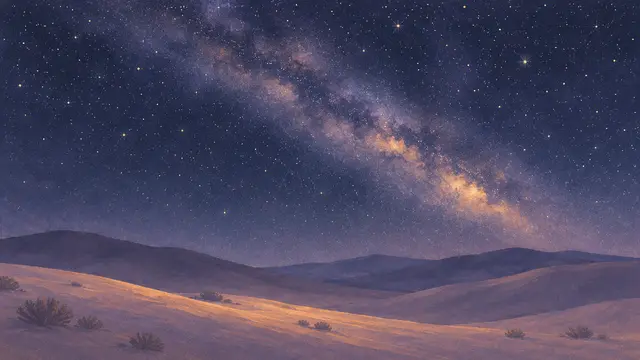
He determines the number of the stars; He calls them each by name.
David marvels that the God who counts the stars also heals the brokenhearted, in the verse just before. Naming each star shows His care for details, and nothing is too small for Him.
When I behold Your heavens, the work of Your fingers, the moon and the stars, which You have set in place—
David looks at the moon and stars, and in the next verse asks why God thinks of people. The vastness of the sky makes human smallness clear, and God's attention to us even more astonishing.
When you look to the heavens and see the sun and moon and stars—all the host of heaven—do not be enticed to bow down and worship what the LORD your God has apportioned to all the nations under heaven.
Moses warns Israel not to be drawn into worshipping the sun, moon and stars, as other nations did. They are for admiring as creation, not for worship, because they were made by God.
Then the wise will shine like the brightness of the heavens, and those who lead many to righteousness will shine like the stars forever and ever.
Daniel is told that the wise will shine like the sky. The verse promises honour to those who help others find righteousness, and it is often used to encourage teachers and mentors.
the moon and stars to govern the night. His loving devotion endures forever.
The psalm praises God for making the sun to rule by day and the moon and stars by night. Each time of day belongs to Him, and the refrain is that His love endures forever.
He who made the Pleiades and Orion, who turns darkness into dawn and darkens day into night, who summons the waters of the sea and pours them over the face of the earth— the LORD is His name—
Amos names the Pleiades and Orion as God's work. He who made these constellations also turns dark to dawn, and the verse supports trusting Him through dark seasons.
For the stars of heaven and their constellations will not give their light. The rising sun will be darkened, and the moon will not give its light.
Isaiah describes the day of the Lord as a time when the stars give no light. It is poetic language for judgement against Babylon, showing the whole heavens shaken by God's action.
Lift up your eyes on high: Who created all these? He leads forth the starry host by number; He calls each one by name. Because of His great power and mighty strength, not one of them is missing.
Isaiah invites his readers to look at the night sky and ask who made it. The same God who calls each star by name will not forget His people, which is the whole point of the chapter.
asking, “Where is the One who has been born King of the Jews? We saw His star in the east and have come to worship Him.”
Magi from the east tell Herod they saw the star of the newborn king. It is the only place where a star leads people toward Jesus, and the details of what they saw are not explained.
And the LORD took him outside and said, “Now look to the heavens and count the stars, if you are able.” Then He told him, “So shall your offspring be.”
God takes Abram outside and tells him to count the stars if he can. At this point Abram had no child, so the promise of countless descendants was an enormous act of faith.
and the stars of the sky fell to the earth like unripe figs dropping from a tree shaken by a great wind.
John's vision uses images of stars falling like figs from a tree. Readers interpret this symbolically or literally in different ways, but the point is that God holds the final word.
God made two great lights: the greater light to rule the day and the lesser light to rule the night. And He made the stars as well.
Genesis says God made two great lights and also the stars. The stars get one short line, but it shows they are part of the careful order of creation.
He is the Maker of the Bear and Orion, of the Pleiades and the constellations of the south.
Job speaks of God as Maker of the Bear, Orion and the Pleiades. Job, in the midst of suffering, remembers God's power over the heavens, which can steady a person facing things beyond control.
And God said, “Let there be lights in the expanse of the sky to distinguish between the day and the night, and let them be signs to mark the seasons and days and years.
God says the lights in the sky will separate day from night and mark seasons. This explains one of their practical roles, and shows that creation was ordered with human life in mind.
while the morning stars sang together and all the sons of God shouted for joy?
God asks Job where he was when the morning stars sang together at creation. It is poetry about the joy of creation, and it puts human questions into a much larger perspective.
The sun has one degree of splendor, the moon another, and the stars another; and star differs from star in splendor.
Paul says that stars differ in glory from each other, as part of explaining the resurrection body. Different kinds of splendour exist, and the picture is of a transformed body far greater than the present one.
The heavens declare the glory of God; the skies proclaim the work of His hands.
David says the heavens declare God's glory without words. Creation is a quiet witness to the Creator that anyone, anywhere, can see.
Josiah also did away with the idolatrous priests ordained by the kings of Judah to burn incense on the high places of the cities of Judah and in the places all around Jerusalem—those who had burned incense to Baal, to the sun and moon, to the constellations, and to all the host of heaven.
Josiah removes priests who burned incense to the stars and planets, as part of his reform of Judah. This shows that star worship was a real temptation in Israel's history.
the stars will fall from the sky, and the powers of the heavens will be shaken.’
Jesus speaks of the stars falling as part of signs of the end. Christians differ on how to read this, but He says it to prepare the disciples, not to frighten them.
I will surely bless you, and I will multiply your descendants like the stars in the sky and the sand on the seashore. Your descendants will possess the gates of their enemies.
God repeats the promise to Abraham after he is willing to offer Isaac, saying his descendants will be as many as the stars. The promise is renewed at a point of great testing.
Stars appear all through Scripture for different reasons. In Genesis 1:14–16 God makes the lights in the sky to mark seasons, days and years, and Psalm 136:9 says the moon and stars govern the night. The point is that the heavenly bodies are made things, not gods. Deuteronomy 4:19 and 2 Kings 23:5 warn against worshipping them, which matters in a world where neighbouring nations did exactly that.
The stars are also a sign of God's greatness and care. Isaiah 40:26 asks who made all these and says He calls each one by name, and Psalm 19:1 says the heavens declare the glory of God. Then God uses stars as a promise. In Genesis 15:5 and 22:17 He tells Abraham his descendants will be as numerous as the stars. The Magi's star in Matthew 2:2 shows God drawing seekers to Jesus.
Some verses look ahead, such as Mark 13:25 and Revelation 6:13, which use language of falling stars to describe dramatic events at the end. Christians read these passages in several ways. Daniel 12:3 offers an encouraging image: those who lead others to righteousness shine like stars. A simple way to use this page is to step outside on a clear night, read Psalm 8 or Isaiah 40:26, and let the size of the sky do its work.
BSB: Berean Standard Bible, public domain since 2023. KJV: King James Version, public domain outside the UK. WEB: World English Bible, public domain. ASV: American Standard Version (1901), public domain. Darby: Darby Translation (1890), public domain. Verses are quoted exactly from eBible.org source files.