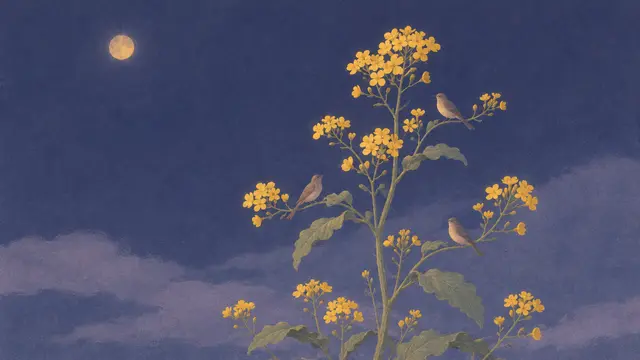
Bible verses about mustard seed come from Jesus' two uses of the image: a tiny seed that grows into a large plant, and faith as small as a seed that can move a mountain. Matthew 13:31–32 and Matthew 17:20 are the best known. Read them to see that small beginnings matter to God, and that faith does not need to be big to be real.
Most-loved Bible verses about mustard seed
“Because you have so little faith,” He answered. “For truly I tell you, if you have faith the size of a mustard seed, you can say to this mountain, ‘Move from here to there,’ and it will move. Nothing will be impossible for you.”
The disciples ask why they could not heal a boy, and Jesus says it was because of their little faith. Faith as small as a mustard seed can say to a mountain, move.
He put before them another parable: “The kingdom of heaven is like a mustard seed that a man planted in his field. Although it is the smallest of all seeds, yet it grows into the largest of garden plants and becomes a tree, so that the birds of the air come and nest in its branches.”
Jesus gives a parable of the kingdom: a man sows a mustard seed, the smallest of seeds, which grows into the largest garden plant, big enough for birds to perch in.
And the Lord answered, “If you have faith the size of a mustard seed, you can say to this mulberry tree, ‘Be uprooted and planted in the sea,’ and it will obey you.
The apostles ask the Lord to increase their faith. He answers that if they have faith like a mustard seed, they could tell a mulberry tree to be uprooted and planted in the sea.
Then He asked, “To what can we compare the kingdom of God? With what parable shall we present it? It is like a mustard seed, which is the smallest of all seeds sown upon the earth. But after it is planted, it grows to be the largest of all garden plants and puts forth great branches, so that the birds of the air nest in its shade.”
Mark's account of the mustard seed parable describes the seed as the smallest of all seeds on earth that grows to be the greatest of garden plants, with large branches.
It is like a mustard seed that a man tossed into his garden. It grew and became a tree, and the birds of the air nested in its branches.”
Luke has the same parable, with the seed tossed into a garden, growing into a tree, and birds nesting in its branches. It is a short picture of the kingdom's growth.
“Truly I tell you,” Jesus replied, “if you have faith and do not doubt, not only will you do what was done to the fig tree, but even if you say to this mountain, ‘Be lifted up and thrown into the sea,’ it will happen.
After the fig tree withers, Jesus tells his disciples that if they have faith and do not doubt, they can do this, and say to a mountain, be taken up and thrown into the sea.
“Have faith in God,” Jesus said to them. “Truly I tell you that if anyone says to this mountain, ‘Be lifted up and thrown into the sea,’ and has no doubt in his heart but believes that it will happen, it will be done for him. Therefore I tell you, whatever you ask for in prayer, believe that you have received it, and it will be yours.
Jesus says to have faith in God and tells them that whoever believes without doubting will have what they say. He adds that when you stand praying, forgive anyone you hold something against.
Then Jesus asked, “What is the kingdom of God like? To what can I compare it?
Luke introduces the mustard seed parable with a question, what is the kingdom of God like, and to what shall I compare it. Jesus answers with the seed.
Now faith is the assurance of what we hope for and the certainty of what we do not see.
The writer says faith is the assurance of things hoped for, and the conviction of things not seen. It describes what a mustard seed of faith holds, which is confidence in God.
Jesus also said, “The kingdom of God is like a man who scatters seed on the ground. Night and day he sleeps and wakes, and the seed sprouts and grows, though he knows not how. All by itself the earth produces a crop—first the stalk, then the head, then grain that ripens within. And as soon as the grain is ripe, he swings the sickle, because the harvest has come.”
Jesus tells a parable of a farmer who scatters seed and sleeps, while the seed grows by itself. He does not know how, and the earth produces grain on its own.
Its leaves were beautiful, its fruit was abundant, and upon it was food for all. Under it the beasts of the field found shelter, in its branches the birds of the air nested, and from it every creature was fed.
Nebuchadnezzar's dream of a great tree has birds nesting in its branches. Jesus' parable uses similar language, picturing a kingdom that offers shelter to many.
Afterward the disciples came to Jesus privately and asked, “Why couldn’t we drive it out?”
The disciples come to Jesus privately and ask why they could not drive out the demon. It is a good question for anyone who has tried and failed.
I will plant it on the mountain heights of Israel so that it will bear branches; it will yield fruit and become a majestic cedar. Birds of every kind will nest under it, taking shelter in the shade of its branches.
God promises to plant a tender shoot on Israel's high mountain, where it becomes a great cedar, and birds will nest in it. It is an Old Testament picture behind Jesus' parable.
If I have the gift of prophecy and can fathom all mysteries and all knowledge, and if I have absolute faith so as to move mountains, but have not love, I am nothing.
Paul says if he has faith that can move mountains, but does not have love, he is nothing. Faith is meant to work with love.
Then God said, “Behold, I have given you every seed-bearing plant on the face of all the earth, and every tree whose fruit contains seed. They will be yours for food.
God gives people every seed-bearing plant for food. Seeds are part of the creation design for growth, which gives the parables their natural background.
And as he was sowing, some seed fell along the path, and the birds came and devoured it.
This is the first seed in the parable of the sower. Some seed falls on the path and birds eat it, and Jesus later explains that the seed is the word of the kingdom.
But the seed sown on good soil is the one who hears the word and understands it. He indeed bears fruit and produces a crop—a hundredfold, sixtyfold, or thirtyfold.”
Jesus says the seed on good soil is the one who hears the word and understands it, and bears fruit. Good soil is the hearts that receive it.
Now He who supplies seed to the sower and bread for food will supply and multiply your store of seed and will increase the harvest of your righteousness.
Paul says God who supplies seed to the sower and bread for food will supply and multiply your seed for sowing. It links seed with generosity in the church.
The grace of the Lord Jesus Christ, and the love of God, and the fellowship of the Holy Spirit be with all of you.
Paul closes 2 Corinthians with a blessing of the grace of the Lord Jesus, the love of God and the fellowship of the Holy Spirit. It does not speak of seeds, but of the grace that makes growth possible.
If a man consecrates to the LORD a parcel of his land, then your valuation shall be proportional to the seed required for it—fifty shekels of silver for every homer of barley seed.
This law values a field according to the amount of seed it needs, such as a homer of barley seed at fifty shekels of silver. It shows how everyday seed was in Israel's life.
What the Bible says about mustard seed
Jesus uses the mustard seed in two ways. In the parable of the kingdom, found in Matthew 13:31–32, Mark 4:30–32 and Luke 13:18–19, the tiny seed grows into a tree large enough for birds to nest in. He is saying that God's kingdom begins small and unnoticed, then grows beyond what anyone expected.
In the second use, he speaks of faith. When the disciples could not heal a boy in Matthew 17:19–20, Jesus told them that faith as small as a mustard seed could move a mountain. In Luke 17:6 the apostles asked for more faith while being told to forgive repeatedly, and he said a seed's worth could uproot a mulberry tree and plant it in the sea. Matthew 21:21 and Mark 11:22–24 make a similar point after the fig tree withers.
These sayings are not a formula for getting everything you ask for, or a claim that doubt cancels prayer. The point is the quality of faith, not the amount, since even a small trust in a great God does things. Hebrews 11:1 defines faith as confidence in what we hope for. Paul adds in 1 Corinthians 13:2 that even mountain-moving faith is nothing without love.
The next time you feel your faith is too small, read Mark 4:26–29, where the seed grows by itself while the farmer sleeps. God does the growing.